

“What’s the actual difference between the AMSaudio GT5000 and GT6000? Why is the price different?”
So today, let’s break it down properly — not just the specs, but the real-world difference between these two systems, and why AMSaudio has earned growing confidence as a Chinese professional audio brand in recent years.
Both the GT5000 and GT6000 are excellent wireless systems, but they’re built around very different antenna architectures.
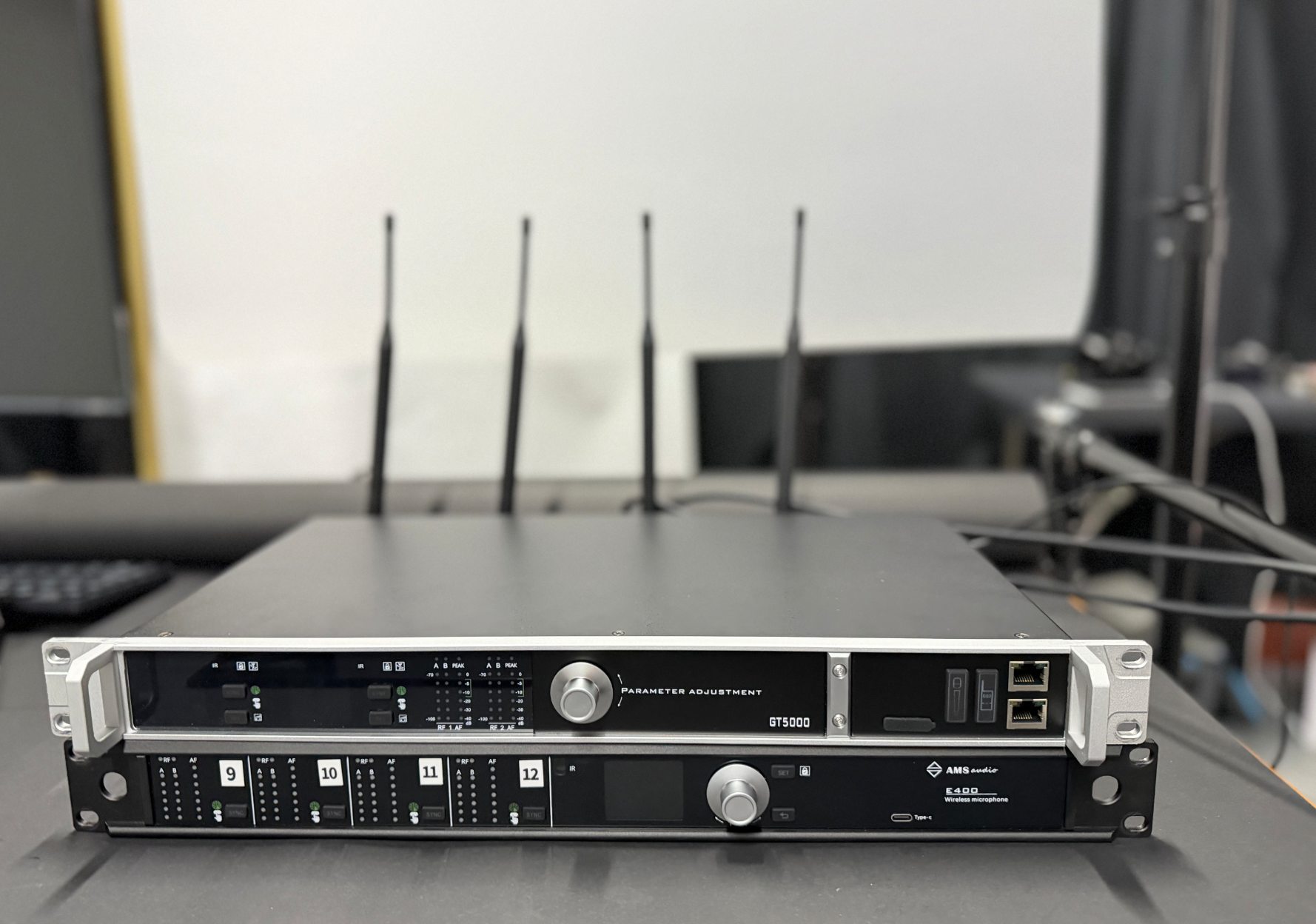
The GT5000 is designed around standard omnidirectional dipole antennas — the typical “rod antennas” mounted on the back of the receiver. For everyday applications, this setup works perfectly well and keeps costs reasonable.
However, if you want to use directional paddle antennas — the “shark fin” style antennas commonly used in professional touring setups — the GT5000 cannot connect to them directly.
You’ll need an external antenna distribution system.
The signal flow looks like this:
Directional paddle antennas → UC80 antenna distributor → GT5000 receivers
That means:
one extra device,
more cabling,
more rack space,
more setup time,
and naturally, more cost.
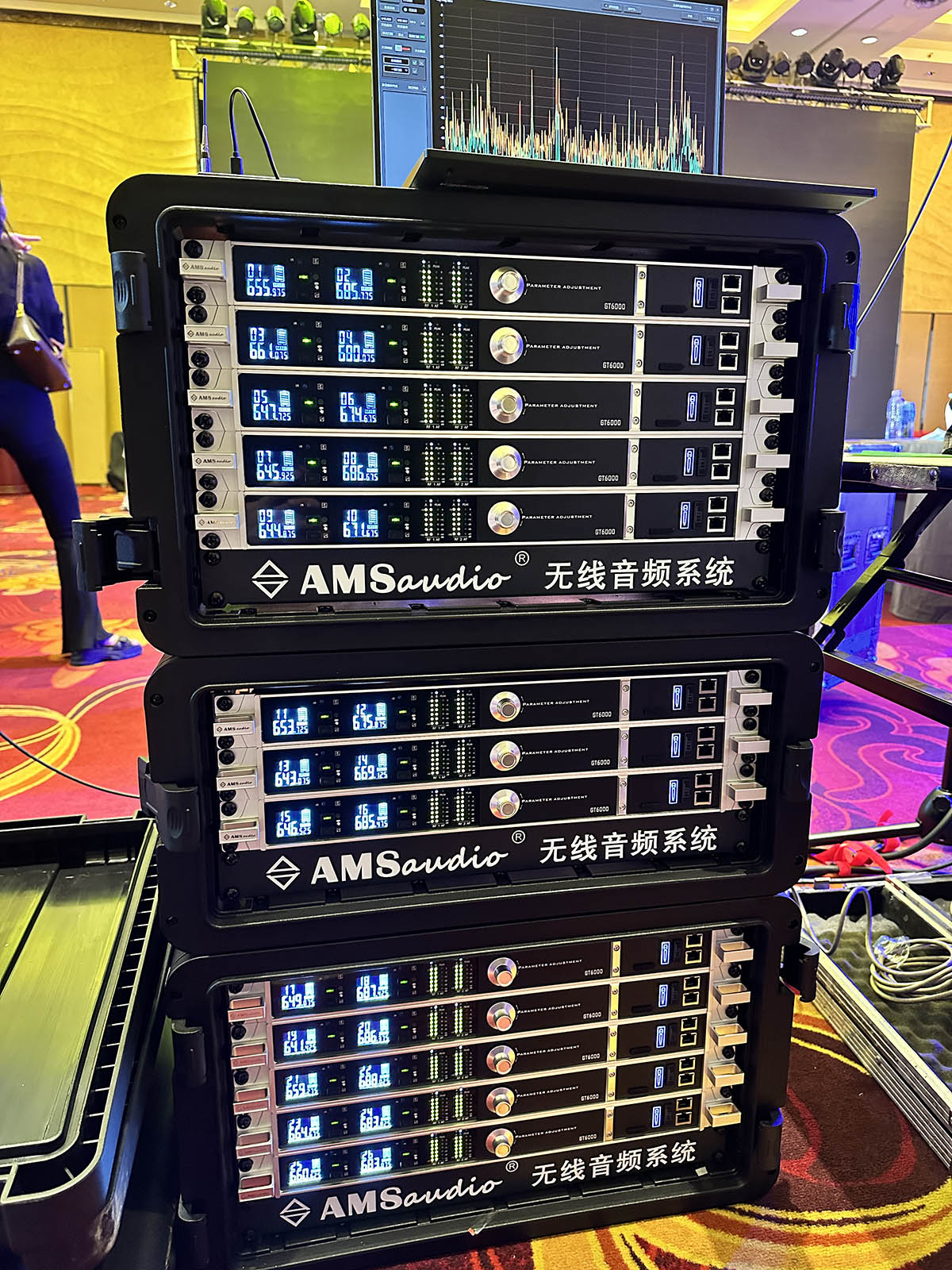
The GT6000 is built differently.
It supports cascade output, allowing up to four receivers to link directly together. One unit feeds the next, then the next, and so on — making multi-channel setups far cleaner and easier.
More importantly, the GT6000 includes built-in cable loss compensation and supports active paddle antennas with direct power supply.
That means it can connect directly to either:
standard omnidirectional rod antennas, or
professional directional paddle antennas
No external antenna distributor is required for basic directional antenna operation. You simply connect the antenna feed lines directly into the A/B antenna inputs on the receiver.
For larger multi-channel systems, an antenna distributor is still recommended — typically one paddle antenna pair shared across 4–6 receivers — but the GT6000 dramatically simplifies the workflow.
So in practical terms:
GT5000 + paddle antennas = requires a UC80
GT6000 + paddle antennas = direct connection
And once you factor in the price of an antenna distributor like the UC80, the total system cost of a GT5000 setup starts getting surprisingly close to the GT6000 anyway.
The GT6000 doesn’t just save money in the long run — it also saves rack space, setup complexity, and troubleshooting time.
And anyone who works large-scale live events knows:
less gear usually means fewer problems.
To be honest, years ago, many people in live production were still cautious whenever they heard the phrase “Chinese audio brand.”
But the industry has changed fast.
The GT6000, for example, uses many imported key components, and its signal-to-noise ratio and dynamic range are already competitive with major international brands — while remaining far more cost-effective.
A lot of engineers around me who’ve used AMSaudio systems on real shows say the same thing:
“These systems have genuinely proven themselves.”
From music festivals to corporate events, AMSaudio equipment has handled countless demanding productions with impressive stability.
And in our industry, reliability is everything.
Modern live venues are packed with wireless interference:
lighting systems,
LED walls,
intercoms,
Wi-Fi,
wireless cameras,
and countless RF devices all competing in the same environment.
If a wireless system can’t handle interference properly, dropouts happen — and one frequency failure can ruin an entire show.
The GT6000 features one-touch intelligent frequency scanning, automatically finding clean frequencies quickly and efficiently.
In complex RF environments, that kind of stability matters more than marketing specs.
That’s the kind of reliability frontline engineers actually care about.
Price remains one of the strongest advantages for Chinese professional audio brands.
Compared with international brands like Shure and Sennheiser, AMSaudio delivers comparable real-world performance at a significantly lower price point — often half the cost or even less.
The GT5000 is a great fit for:
small to medium-sized events,
tighter budgets,
and users who only occasionally need directional antenna systems.
A GT5000 paired with a UC80 still offers excellent value for money.
If you regularly handle:
medium-to-large live productions,
multi-channel wireless systems,
or frequent directional antenna deployments,
then the GT6000 simply makes more sense.
Because over time, it saves:
antenna distribution hardware,
rack space,
setup time,
cable complexity,
and signal loss.
It also allows up to four receivers to share one antenna system through cascading, making large-scale installations cleaner and more efficient.
And in professional live production, peace of mind on show day is worth far more than a small price difference.
The live event industry is more competitive than ever, and every investment needs to deliver real value.
Reliable equipment means fewer headaches and more confidence on site.
Over the past few years, AMSaudio has shown that Chinese professional audio brands are no longer competing on price alone — they’re competing on performance, reliability, and real-world usability.
Whether you choose the GT5000 or GT6000, both systems reflect solid engineering, practical design, and the kind of dependable support professionals actually need.
At the end of the day, choosing audio equipment is a lot like choosing teammates.
When the pressure is on, the gear that doesn’t let you down is the gear worth trusting.
Copyright © 2026 Global Vision English Network All Rights Reserved
 Marrakesh: The Jewel of Morocco
 Exploring Rabat: 21 Must-Visit Places Where History
 Fes Festival of Sacred Music: A Journey Through the
 Steal a Lazy Moment and Escape the Hustle and Bustl